
01
Development debt on the vines
Long-term, matched to a productive life measured in decades, ideally with interest only through the establishment period.
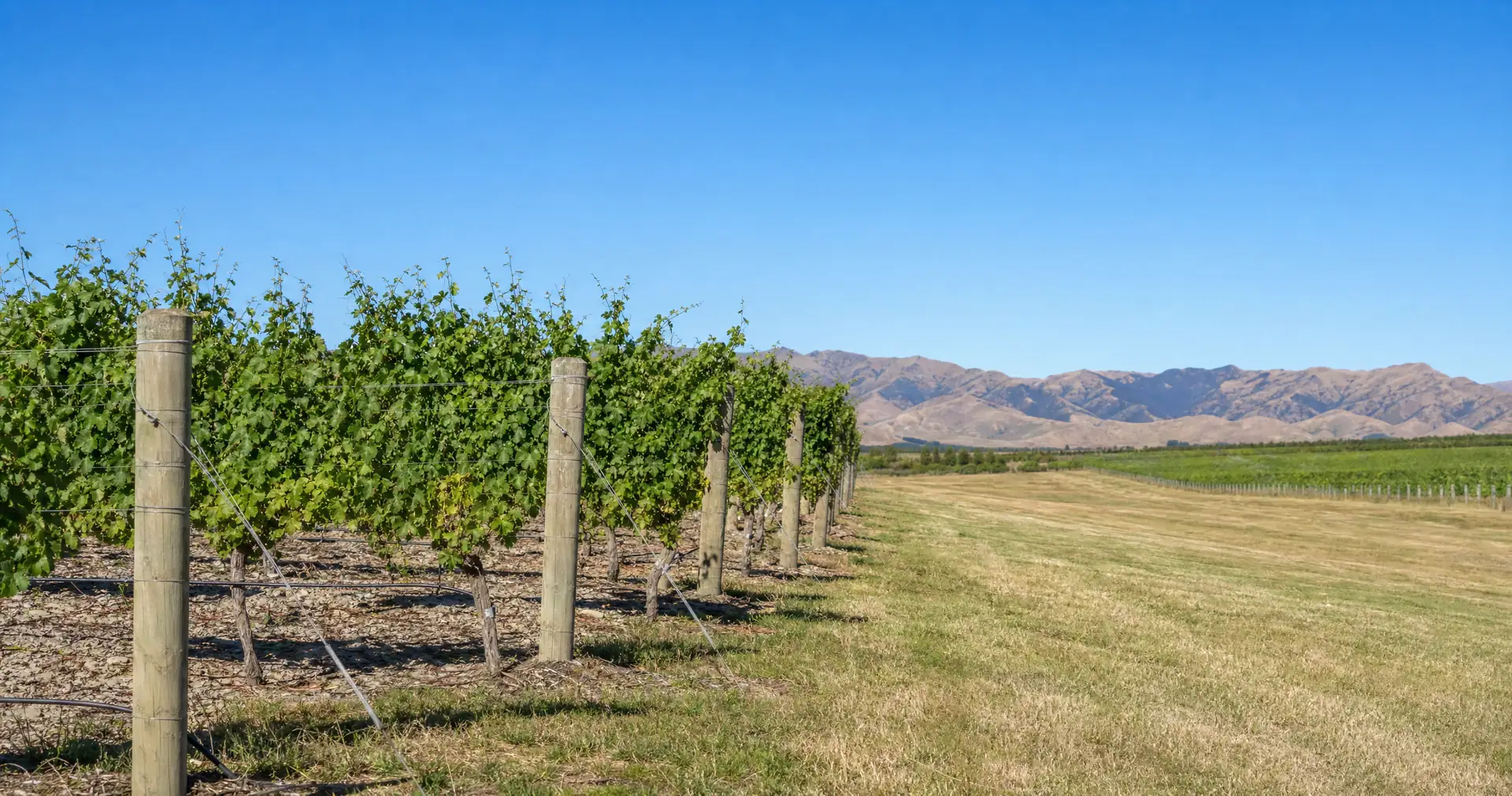
A vineyard has the longest establishment period of any New Zealand horticultural crop, and where the business also makes wine the wait between cost and revenue stretches further again.
Last reviewed 8 September 2026
Indicative repayment
Weekly
$2,395/week
Indicative only. Not a quote or offer of credit. Actual rates, fees, and repayments depend on the business profile and the lender's decision.
Sending to Prospa
5 years at 9.00% . Prospa will ask a few quick questions, then provide a firm quote and funding if eligible.
Redirecting…
The short version
The two businesses
A grower supplying fruit under contract has a cash year resembling other horticulture: costs through the season, harvest, and payment in stages afterwards. It is long by pastoral standards and it is finite, and a seasonal facility clearing each year handles it.
A business that also makes wine has a different problem entirely. The fruit becomes wine, the wine sits in tank or barrel for a period set by the style, and it is then bottled, labelled and sold across months or years. Every dollar of that is working capital tied up in inventory.
Where both happen in one business, the funding has to accommodate an establishment period, an annual growing cycle and an inventory position, and those three are best kept in separate facilities. A single limit trying to do all three obscures which part is under pressure.
Grower
Paid on fruit
Winery
Paid on wine sold
Between them
Months to years
Funded by
Different facilities
Worked example
A small winery makes wine from its own fruit with a production cost of roughly $600,000 for a vintage, and the style requires it to be held before release and then sold across the following eighteen months.
From the point the fruit is picked, that $600,000 is inventory rather than cash, and it converts back gradually as the wine sells. At any moment the business is holding a substantial part of one vintage and beginning the next, so the working capital requirement is larger than one vintage rather than equal to it.
Funding that on a seasonal facility that is expected to clear annually will not work, because the inventory does not clear annually. A facility sized and structured for inventory, or a longer arrangement, is what fits, and recognising that is the difference between a winery that grows comfortably and one that is permanently at its limit.
Illustrative figures
Illustrative on stated assumptions and rounded. Not a projection for any particular business.
The vintage risk
A spring frost, a wet harvest or a disease outbreak can take a vintage after the whole season’s costs have been incurred. Unlike a pastoral system, where a poor season reduces production, a vineyard can lose a year outright, and the debt against the vines continues. That is the risk that most distinguishes the sector, and it is the reason a vineyard facility should be sized with the tolerance to survive a lost vintage rather than sized against an average one.
The finance around it
01
Long-term, matched to a productive life measured in decades, ideally with interest only through the establishment period.
02
Carrying the growing year: pruning, canopy work, crop protection, harvest labour and contracting. Clears as fruit or wine income arrives.
03
Where the business makes wine, the stock in tank, barrel and bottle is a substantial standing position that does not clear annually.
04
Tanks, presses and bottling plant, financed like any other machinery and competing for the same servicing capacity.
Contract or estate
A grower supplying under contract has a defined price mechanism, a known buyer and a payment schedule. That is a considerably more fundable position than an estate business, because the income is contracted rather than dependent on selling a product into a market.
An estate business captures far more of the value and carries the whole of the marketing, inventory and price risk to do it. It also holds a brand, which is real value and difficult security.
Lenders read the two differently, and a business moving from one to the other is changing its risk profile rather than only its strategy. That is worth raising with a lender in advance rather than presenting as a fait accompli at the next review.
From a lender’s side
The honest position
The structure that works separates development, the growing season and inventory. Each has a different length, a different repayment source and a different signal when it goes wrong, and a single facility carrying all three tells the business nothing.
The most common failure is inventory funded on a seasonal limit. The limit does not clear, the business concludes it is under-sized, the limit is raised, and the cycle repeats until the facility is permanently drawn. What was actually happening was a working capital position being funded on the wrong instrument.
Getting the separation right at the outset is difficult to unpick later, which makes it worth a specific conversation with a lender who understands the sector rather than a general business banker.
The plantings
A vineyard is valued on what is planted as well as on the land. Variety, clone, rootstock, age, row spacing, trellis and the condition of the vines all affect what the block can produce and therefore what it is worth, and a valuation on a producing vineyard is a considerably more involved exercise than one on bare land.
Age cuts both ways. Young vines have not reached full production and old vines may be approaching replanting, and both positions are discounted against a block in its productive prime. A purchaser buying a mature vineyard is buying a defined number of remaining productive years.
That is why replanting is a recurring capital item on an established business rather than a one-off. A vineyard that never replants is a vineyard whose production is declining, and funding a rolling replanting programme is part of running one properly.
Structuring it
01
Long-term, matched to a productive life measured in decades, ideally with interest only through the establishment period so the repayment begins when the block does. This is the facility that most often gets set up over too short a term.
02
Pruning, canopy work, crop protection, harvest labour and contracting, drawn as they are incurred and cleared as fruit or wine income arrives. It should return to zero each year, and if it does not, something from another category has been funded on it.
03
Stock in tank, barrel and bottle is a standing position that does not clear annually, and it needs a facility structured for that. Funding it on the seasonal limit is the most common structural error in the sector and it takes years to become visible.
When it goes wrong
A frost, a wet harvest or a disease event removes a year of fruit after the season’s costs have been spent and while the development debt continues.
What happens:A year of revenue gone with the cost base intact, and for a winery a gap in the inventory that appears in sales two years later.
Inventory that was budgeted to clear across eighteen months takes considerably longer, so working capital stays tied up while the next vintage arrives.
What happens:A facility that does not clear and a business carrying two vintages of stock on funding sized for one.
A grower supplying under contract finds the arrangement ends or changes, and the fruit has to be sold elsewhere or made into wine the business had not planned to make.
What happens:The income that justified the facility replaced with something less certain, on a block that cannot be repurposed quickly.
The second is the one most often underestimated, because it looks like a sales problem and behaves like a funding one. Inventory that moves more slowly than budgeted ties up capital that the next vintage also needs.
The development cost
The calculator runs the ordinary amortising arithmetic. A longer term than this shape allows is frequently the right structure for plantings with a productive life of decades. Indicative only, and not a quote or offer of credit.
Indicative repayment
Weekly
$2,395/week
Indicative only. Not a quote or offer of credit. Actual rates, fees, and repayments depend on the business profile and the lender's decision.
Sending to Prospa
5 years at 9.00% . Prospa will ask a few quick questions, then provide a firm quote and funding if eligible.
Redirecting…
References
The agency publishing New Zealand viticulture and wine sector information, and responsible for biosecurity.
Context for New Zealand vineyard area, production and wine export volumes.
Context for wine export markets and the arrangements estate businesses operate under.
The source for seasonal employment obligations across pruning and harvest.
Context for New Zealand rural lending aggregates and rate movements.
FAQ
Several years to a commercial crop and longer to full production, which is the longest establishment period of any New Zealand crop. The funding term should match that rather than a standard business loan length.
A grower is paid after vintage on a contracted mechanism. A winery is paid after the wine is made, held, bottled and sold, which is months or years later and carries market risk the grower does not.
Because the production cost of a vintage becomes stock that cannot be sold yet, and it converts back gradually. The business holds part of one vintage while beginning the next, so the requirement exceeds one vintage.
Poorly. A seasonal facility is expected to clear annually and inventory does not, so the limit stays drawn, gets raised, and stays drawn again. A facility structured for inventory is the right instrument.
The season’s costs have already been spent and the revenue does not arrive, while the debt against the vines continues. A frost, a wet harvest or a disease event can do it, which is why tolerance in the facility matters here more than in pastoral systems.
With three facilities rather than one. Long-term development debt matched to the plantings, a seasonal facility for the growing year, and inventory funding where the business makes wine. Each has a different length and a different repayment source.
Ordinarily yes. A defined price mechanism, a known buyer and a payment schedule make the income considerably more predictable than selling wine into a market, and lenders read the two differently.
It is real value and difficult security. A lender can see it in the returns and cannot readily lend against it, so an estate business is assessed more on its land, plantings, plant and inventory than on the brand it has built.
An estate business selling offshore carries currency and market risk that a domestic grower does not, and receivables from export customers behave differently from a domestic contract payment.
A development budget with the establishment period stated honestly, several years of production history where vines already exist, an inventory position set out separately, and a payment schedule built from net returns.
A lender who understands the sector is worth finding. The structure this business needs is unusual, and the most common failure is a facility set up by someone who treated inventory and development as one working capital requirement.
No. It describes a sector’s cash year in general terms. This site is not a lender, a broker or a registered financial adviser, and what suits a particular business depends on facts a website cannot see.
Related
Horticulture
The same shape over a shorter establishment.
Read onIrrigation finance
Frequently part of a vineyard development.
Read onSeasonal finance
The facility carrying the growing year.
Read onSeasonal cash flow by sector
Where viticulture sits against the others.
Read onAll seven sectors
Every production calendar compared in the same shape.
Read onDisclaimer
Farm debt is serviced out of a production year that does not arrive evenly, and it is commonly secured on the land and the stock the business depends on. Modelling the cost against the season before committing is what this site is built for. Borrowing at a level that stays comfortable through a poor season, rather than only through an average one, is widely regarded as the safer frame.
What this site is
A calculator and information tool. Not a lender, not a broker, not a registered financial adviser. Nothing here is personalised financial advice.
What the figures show
Modelled estimates based on the inputs shown. Not a quote. Not an offer of credit. Not a guarantee of approval, rate or fees.
What the lender decides
Final rates, fees, and approval are set by the lender after a CCCFA-appropriate assessment of the applicant's circumstances and credit decision.
Commercial disclosure
Farmfinance.org.nz earns a commission from Prospa when a visitor applies through this site and their application is approved. The commission is paid by Prospa, not by the borrower, and it does not influence the rate Prospa offers. Full disclosure on the partner page.
Tax, GST, and accountant framing
Tax-treatment statements (GST claim timing, interest deductibility, depreciation rates) are general in nature and subject to the accountant's confirmation on the specific business position. For material amounts, professional advice from a registered financial adviser or chartered accountant is widely regarded as the safer frame.