
01
The consent or scheme position
Term, conditions, reliability of supply and transferability. Reliable water on a long consent supports a very different position from an unreliable or short one.
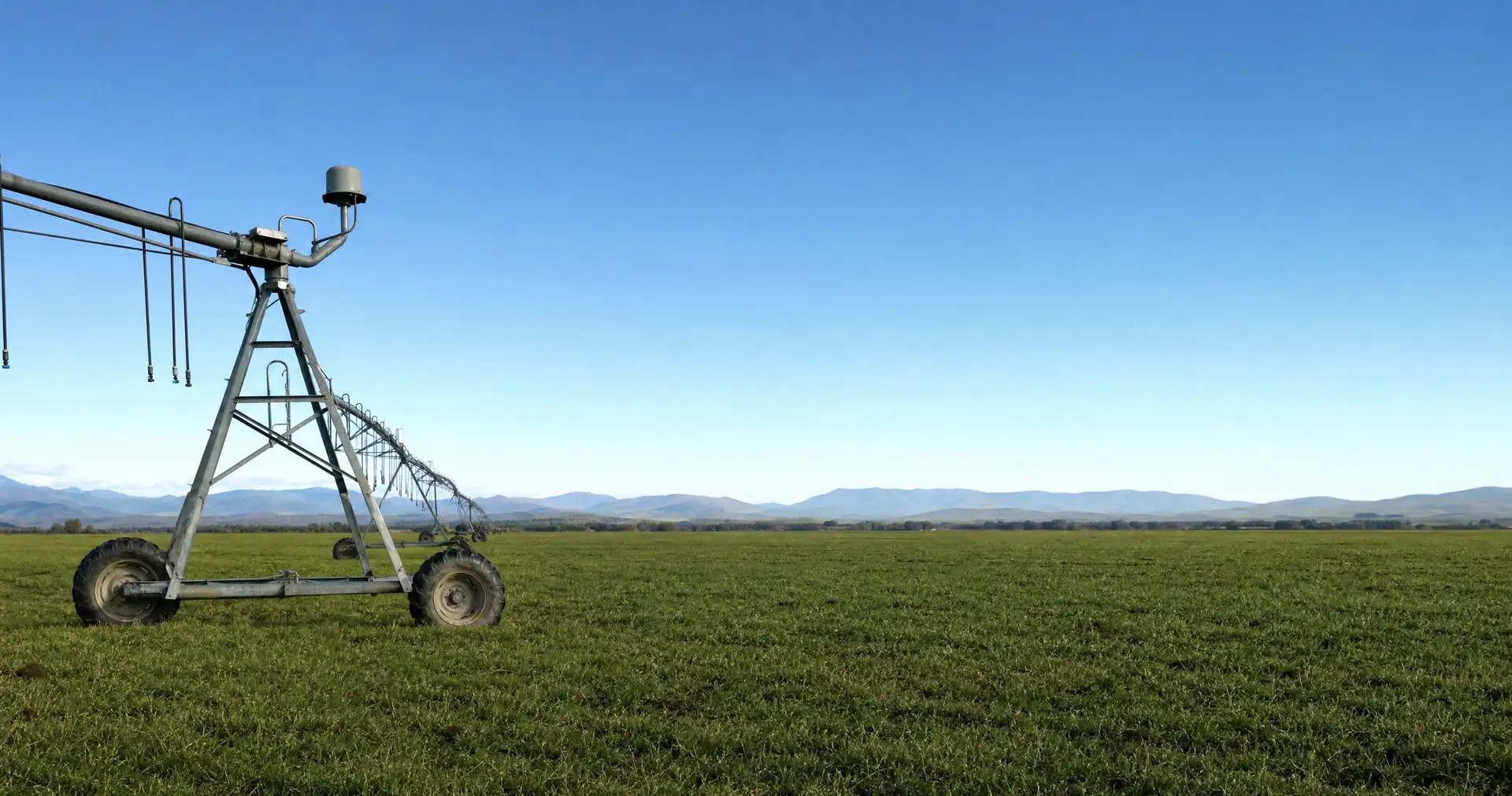
Irrigation is the largest development most farms undertake, it lifts production for a generation, and it depends on a consent the farm does not own outright.
Last reviewed 8 September 2026
Indicative repayment
Weekly
$2,156/week
Indicative only. Not a quote or offer of credit. Actual rates, fees, and repayments depend on the business profile and the lender's decision.
Sending to Prospa
5 years at 9.00% . Prospa will ask a few quick questions, then provide a firm quote and funding if eligible.
Redirecting…
The short version
What is being funded
The water right comes first, either as a private take consent or as shares in an irrigation scheme. In the second case the shares have a market value, an acquisition cost and ongoing charges, and they are frequently a substantial share of the total project.
The infrastructure is the visible part: pumps, mainlines, pivots or other application systems, and the earthworks to install them. It has a long working life and it is fixed to the property, which is why it forms part of the land value rather than sitting outside it.
Power supply is the component most often underestimated. An upgrade to the connection, transformer capacity and the ongoing electricity cost of running the system are all real and all arrive with the project rather than after it.
The consent
Or scheme shares
The infrastructure
Pumps, mains, pivots
Power
Supply and connection
The development gap
Before production lifts
Worked example
A $450,000 irrigation development is expected to lift production materially from the second season onward. Financed over five years at an indicative 9%, the repayment is roughly $2,150 a week, which is about $112,000 a year.
The additional production takes two seasons to arrive fully, so the first two years carry the full repayment against part of the benefit. That is the squeeze, and it is where irrigation developments cause difficulty on farms that were otherwise comfortable.
Financed over fifteen years, or as part of the term debt secured on the land, the annual cost falls substantially and the repayment profile matches when the benefit actually arrives. The total interest paid is higher and the farm survives the development, which is the trade worth making on an asset that will still be working in thirty years.
Illustrative figures
Illustrative on stated assumptions and rounded. Not a quote or offer of credit.
The consent question
Irrigation infrastructure is worth what the water right allows it to do, and a take consent has a term, conditions and a renewal process rather than being permanent. A lender assessing a development looks at how long the consent runs, what it permits, what conditions attach to it and how renewal is likely to be treated under current freshwater policy. A development funded over fifteen years against a consent with eight years to run is a position both parties should understand before it is signed, and the answer is a matter of record rather than opinion.
What a lender assesses
01
Term, conditions, reliability of supply and transferability. Reliable water on a long consent supports a very different position from an unreliable or short one.
02
What the development is expected to add, tested against conservative prices and against what comparable developments have actually achieved rather than what the proposal assumes.
03
How long before the benefit arrives, and how the farm covers the repayment in the meantime. This is where an otherwise sound project causes trouble.
04
Nutrient limits, monitoring and reporting requirements attached to the take. These are ongoing costs and constraints that affect what the additional production can be.
Scheme shares
Where water comes from an irrigation scheme, access ordinarily depends on holding shares proportionate to the area irrigated. Those shares have a market value, they are bought and sold, and they can form part of a security package. They also carry annual charges regardless of how much water is taken in a given season.
That produces two funding lines rather than one. The infrastructure on the farm is one asset with one life, and the shares are another with a different character, and lenders frequently treat them separately. A project priced as a single figure needs unpicking into the two.
The ongoing charges are the part most often underestimated in a development budget. They arrive every year including dry ones where the water was worth a great deal and wet ones where it was barely used, and they belong in the operating budget rather than in the capital calculation.
The trade
The honest position
The two mistakes that cause difficulty on irrigation projects are financing a thirty-year asset over five years, and budgeting for the production benefit arriving faster than it does. Both are avoidable and both are common, and together they account for most of the trouble.
The first is a conversation with the lender about structure rather than about rate. Folding the development into term debt secured on the land, or arranging a longer facility, matches the repayment to the benefit and is ordinarily available on a project of this kind.
The second is a cash-flow exercise rather than a funding one. Modelling the first two seasons with the full repayment and partial benefit, and establishing where that gap comes from, is what turns an ambitious project into a survivable one. Where that gap has no answer, the project is bigger than the farm rather than wrong.
Running cost
An irrigation system has an operating cost every year it runs, and it is larger than most development budgets allow for. Electricity to pump, maintenance on pumps, mainlines and application equipment, scheme charges where water comes from a scheme, and the labour to manage the system all recur.
That figure belongs in the operating budget rather than the capital calculation, and separating the two is what keeps a development honest. A project justified on additional production without the running cost deducted is justified on a number that does not exist.
It also affects the funding conversation directly. A lender assessing an irrigation development is looking at the additional production net of what it costs to produce, and a budget that presents the gross figure invites a question the applicant should have answered.
The trade
When it goes wrong
The system is commissioned late, the first season under irrigation underperforms, or the production lift takes longer to reach than the proposal assumed.
What happens:Full repayment against partial benefit for longer than planned, which is where an otherwise sound project causes difficulty.
A renewal is granted on different terms, an allocation is reduced, or conditions are added that limit what the system can be used for.
What happens:An asset worth less than it was, funded over a term set when the water position looked different.
Power, maintenance and scheme charges come in above what the development budget allowed, every year rather than once.
What happens:A permanent reduction in the net benefit, which compounds across the life of the facility.
All three are addressed at the budgeting stage rather than afterwards. A development modelled with a later benefit, a conservative water position and a realistic running cost is a development that survives being slightly wrong.
The repayment
Irrigation facilities amortise, so the output here is a repayment. A longer term than this shape allows is frequently the right structure for infrastructure with a long life. Indicative only, and not a quote or offer of credit.
Indicative repayment
Weekly
$2,156/week
Indicative only. Not a quote or offer of credit. Actual rates, fees, and repayments depend on the business profile and the lender's decision.
Sending to Prospa
5 years at 9.00% . Prospa will ask a few quick questions, then provide a firm quote and funding if eligible.
Redirecting…
References
The source for New Zealand freshwater policy, water take consents and nutrient regulation.
The agency responsible for rural sector policy, including irrigation and water infrastructure programmes.
The authority for title, including interests recorded against irrigated properties.
Context for New Zealand rural lending aggregates and rate movements.
Backs the distinction between general information of this kind and regulated financial advice.
FAQ
Ordinarily as long-term debt, frequently folded into the term facility secured on the land, because the infrastructure has a working life measured in decades and is fixed to the property.
Because a thirty-year asset financed over five years puts the whole repayment into the years before the production benefit has accumulated. Matching the term to the asset is the single most useful structural decision on a development.
Everything. The infrastructure is worth what the water right allows it to do, and a take consent has a term, conditions and a renewal process. A lender assesses all of that as part of the value.
Where water comes from an irrigation scheme, access ordinarily depends on holding shares proportionate to the area irrigated. They have a market value, they can form part of a security package, and they carry annual charges regardless of use.
Power supply and the development gap. An upgraded connection and the running cost of the system arrive with the project, and the first two seasons carry the full repayment against a partial benefit.
It depends on the system and the sector, and it is ordinarily longer than a proposal assumes. Modelling the first two seasons with full repayment and partial benefit is what turns an ambitious project into a survivable one.
Yes. Nutrient limits, monitoring and reporting attached to a take are ongoing costs and constraints that affect what the additional production can be, and lenders assess them as part of the case.
It forms part of the land value because it is fixed to the property, rather than being separate security in the way plant is. That is one reason it is usually funded within the land facility.
Reliable water changes what a property can produce, and rural valuations reflect that. How much depends on the reliability of the take, its term and the sector, which is a valuer’s question rather than a general one.
The process and the likely outcome depend on regional policy and on the catchment, and both have moved in recent years. It is worth understanding well before a renewal date rather than at it, and it is a question for a resource management specialist.
Lenders frequently treat them separately from the on-farm infrastructure, because they are a different kind of asset with a different life. A project priced as a single figure needs unpicking into the two.
No. It describes how a development is generally funded. This site is not a lender, a broker or a registered financial adviser, and consent and compliance questions belong with a resource management specialist.
Related
Farm term loan
Where a development is frequently folded in.
Read onFarm machinery finance
The other capital item competing for servicing.
Read onArable and cropping
Where irrigation reliability changes the system most.
Read onHow NZ rural lending works
How a development case is assessed.
Read onAll eight kinds of finance
Every rural facility compared in the same shape.
Read onDisclaimer
Farm debt is serviced out of a production year that does not arrive evenly, and it is commonly secured on the land and the stock the business depends on. Modelling the cost against the season before committing is what this site is built for. Borrowing at a level that stays comfortable through a poor season, rather than only through an average one, is widely regarded as the safer frame.
What this site is
A calculator and information tool. Not a lender, not a broker, not a registered financial adviser. Nothing here is personalised financial advice.
What the figures show
Modelled estimates based on the inputs shown. Not a quote. Not an offer of credit. Not a guarantee of approval, rate or fees.
What the lender decides
Final rates, fees, and approval are set by the lender after a CCCFA-appropriate assessment of the applicant's circumstances and credit decision.
Commercial disclosure
Farmfinance.org.nz earns a commission from Prospa when a visitor applies through this site and their application is approved. The commission is paid by Prospa, not by the borrower, and it does not influence the rate Prospa offers. Full disclosure on the partner page.
Tax, GST, and accountant framing
Tax-treatment statements (GST claim timing, interest deductibility, depreciation rates) are general in nature and subject to the accountant's confirmation on the specific business position. For material amounts, professional advice from a registered financial adviser or chartered accountant is widely regarded as the safer frame.