
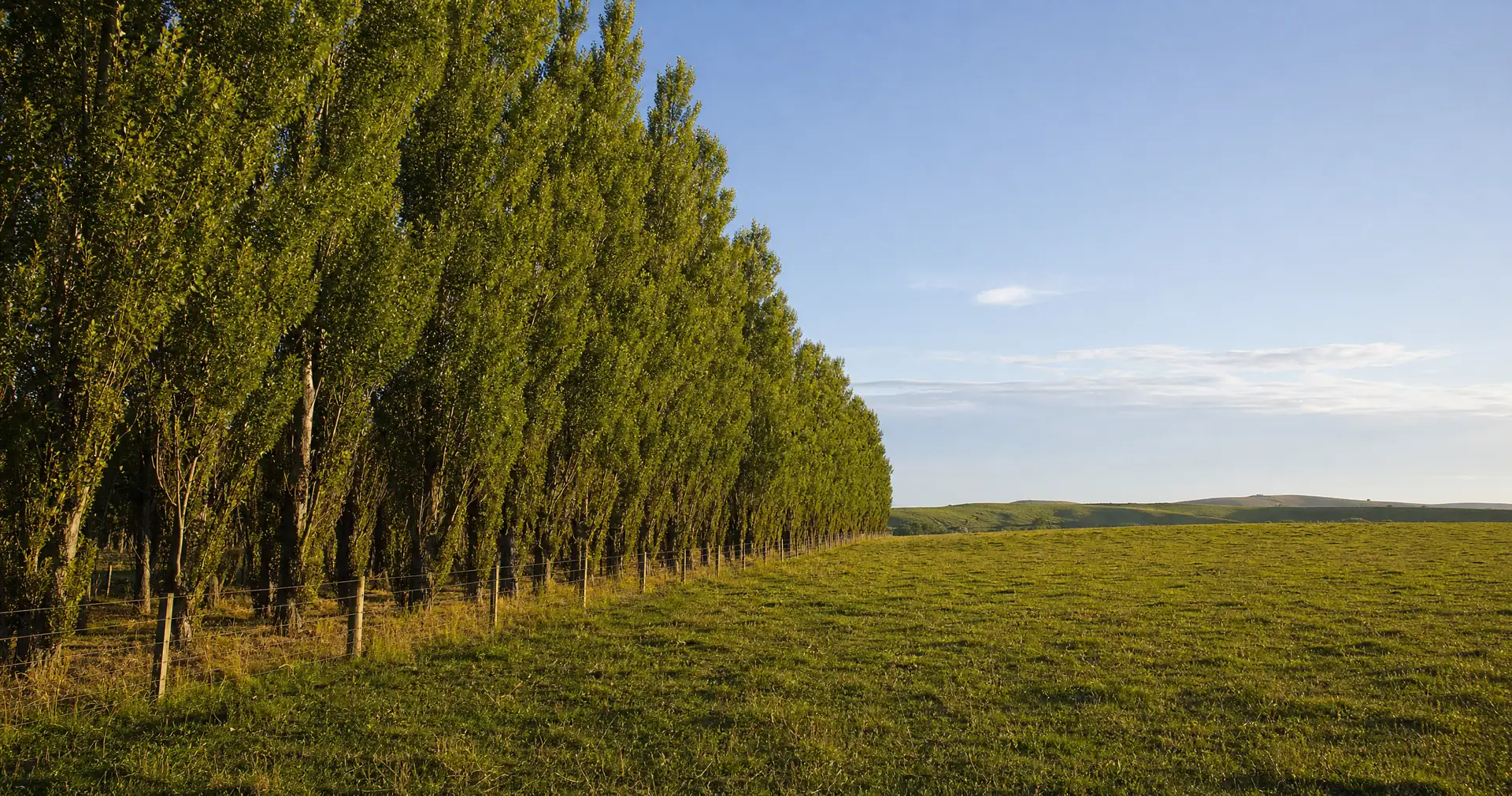
The production calendar shapes the finance.
A dairy farm, an orchard and a forestry block are all farming businesses and none of them has the same cash year. Where the revenue lands, how long the production cycle runs and what the working capital is tied up in all change what the finance has to do. These seven pages start with the sector rather than with the facility.
Dairy
Dairy is unusual among New Zealand farming sectors in receiving income every month, and the amount of those payments depends on a forecast that moves during the season.
Read onSheep and beef
Sheep and beef income arrives in blocks at sale rather than monthly, and the animals being sold are simultaneously the product, the working capital and the security.
Read onHorticulture
A new orchard is a development project with an operating business attached to the end of it, and the finance has to survive the gap between the two.
Read onViticulture
A vineyard has the longest establishment period of any New Zealand horticultural crop, and where the business also makes wine the wait between cost and revenue stretches further again.
Read onArable and cropping
Arable spends on seed, fertiliser, chemical, fuel and machinery through an entire growing season and sells at the end of it, which produces the deepest single drawdown in New Zealand farming.
Read onForestry
Forestry has the longest cash cycle in New Zealand primary production, and almost nothing about ordinary farm finance is shaped for a crop that takes decades.
Read onApiculture
Apiculture spends across a whole year to be ready for a flow that lasts weeks, and both the volume and the price of what it produces can move a long way between seasons.
Read onWhere to start
Seven calendars, and why the calendar decides.
The most useful thing to know about a farming business is the gap between when it spends and when it is paid. Everything about the finance follows from it: how deep the seasonal facility has to be, how much a delayed payment hurts, when a facility should be arranged and which structures fit.
Two properties separate the seven sectors here. Whether income arrives continuously or in events, and whether there is an establishment period before the business produces anything at all. Dairy is alone in receiving income monthly. Horticulture, viticulture and forestry all have establishment periods, and forestry’s is measured in decades.
That grouping explains the funding differences better than an industry list does. A sector with continuous income and no establishment period is the easiest to fund; one with a single receipt after a long establishment is the hardest; and the seven distribute themselves between those poles.
Each page covers where the money goes across a year, when it comes back, where the year is tightest, what the finance around it looks like, and what a lender reads in that sector specifically.
The common thread
Every sector spends before it earns.
None of these sectors is paid in advance. Every one incurs its costs first and receives its income afterwards, and the differences between them are entirely about how long that takes and whether anything arrives in between.
That is why the seasonal facility is close to universal in New Zealand farming and why running one is an ordinary operating arrangement rather than a sign of difficulty. What varies is how deep it goes and how sharply it clears.
It is also why the same discipline applies across all seven: size the facility against the peak rather than the average, arrange it at the strongest point of the year, and record the lowest point it reaches each season. Those three habits are sector-independent and they are worth more than any negotiation about rate.
FAQ
Sectors and their cash years, common questions
Which sector has the smoothest cash year?
Dairy, because monthly payments partly repay the facility continuously rather than leaving it to accumulate until a single sale. That is why dairy carries more debt per hectare comfortably than other pastoral systems.
Which has the deepest seasonal drawdown?
Arable, because a whole year of inputs is spent before anything is sold and nothing arrives in between. The peak falls between harvest costs and payment, which is the tightest window in New Zealand farming.
Why do establishment periods matter?
Because they are a separate funding problem. Horticulture, viticulture and forestry all spend for years before producing, and that development needs long-term debt rather than a facility expected to clear annually.
Does the sector change how a lender assesses a farm?
It changes what is read. Production data, land class and the shape of the cash year all differ, and a rural lender assessing a vineyard is looking at very different information from one assessing a sheep and beef property.
Can a business be in more than one sector?
Frequently, and mixed businesses are common in New Zealand. That ordinarily helps, because a second income stream on a different calendar smooths the year and supports the debt on both.
How do I find my own cash calendar?
Plot twelve months of closing balances from the bank statements on one line. It is more accurate than any general description, and doing it for two or three years separates the pattern from the noise.
Do these pages cover farming practice?
No. They cover where the money goes and when it comes back, and what that means for the finance. Production advice belongs with an industry body or a consultant rather than a finance site.
Which sector is hardest to fund?
The ones combining a long establishment with a single receipt, which is forestry and to a lesser extent viticulture. The funding is against land and other income rather than against production for most of the cycle.