
01
Hive numbers and condition
The productive asset, and the thing any security is over. Condition matters as much as count, and both move with the season.
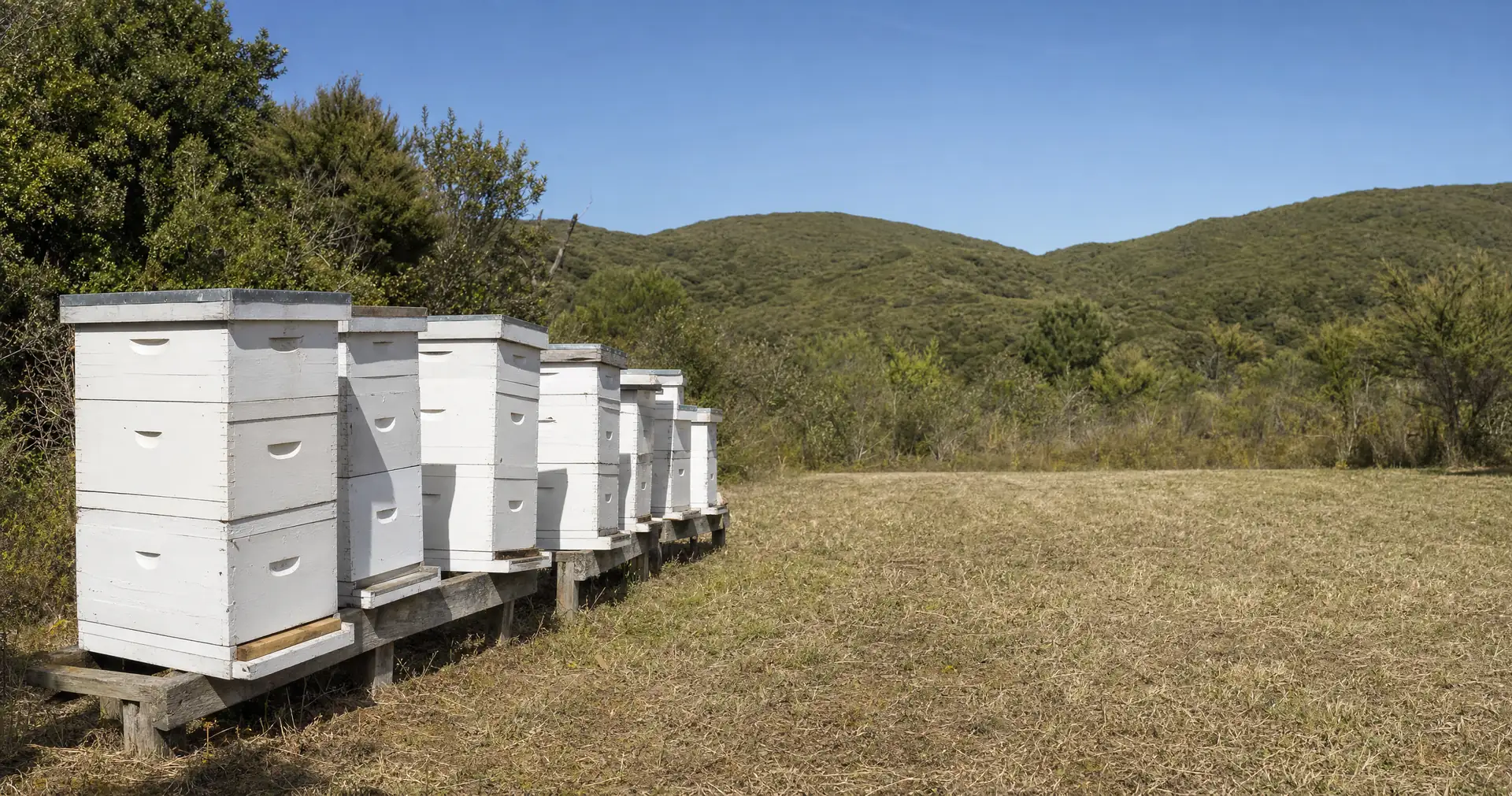
Apiculture spends across a whole year to be ready for a flow that lasts weeks, and both the volume and the price of what it produces can move a long way between seasons.
Last reviewed 8 September 2026
Indicative repayment
Weekly
$1,613/week
Indicative only. Not a quote or offer of credit. Actual rates, fees, and repayments depend on the business profile and the lender's decision.
Sending to Prospa
2 years at 11.00% . Prospa will ask a few quick questions, then provide a firm quote and funding if eligible.
Redirecting…
The short version
The cash year
The costs run continuously. Winter feeding, disease treatment, hive maintenance, replacement equipment and the labour to manage sites all accumulate through the months when nothing is being produced, and they accumulate whether the coming season will be good or not.
Spring is the build-up, when hive numbers and strength are established for the season ahead. That is the period that determines what the harvest can be, and it is also a period of intense labour and travel cost.
The flow itself is short. Weather over a few weeks determines whether a season produces well, poorly or barely at all, and the whole year’s cost base has already been committed by the time that is known. Extraction, processing, testing and sale then follow, so the income arrives well after the flow has ended.
Winter
Feeding and treatment
Spring
Build-up and splitting
Flow
Weeks, weather-dependent
After
Extraction and sale
The volatility
In most farming sectors, volume varies with the season and price varies with the market, and a bad year in one is frequently offset by the other. Apiculture has seen both move substantially in the same direction, which produces year-to-year variation in returns that is wider than pastoral farming experiences. A facility sized against a good season, or a budget built on the last strong year, is a considerably riskier position here than the same approach would be elsewhere, and lenders assess the sector with that in mind.
Worked example
A business finances $150,000 to increase hive numbers, over two years at an indicative 11%. The repayment is roughly $1,750 a week, or about $91,000 a year including interest.
Against that sits what the additional hives produce, which depends on the flow, the sites available and the price achieved. On a strong season the arithmetic works comfortably. On a weak one the additional hives still require feeding, treatment and labour and produce very little, and the repayment continues.
That asymmetry is the reason expansion in this sector is better staged than done in one step. Building numbers across several seasons spreads the exposure, proves the additional sites, and avoids committing a whole expansion to a single season’s weather.
Illustrative figures
Illustrative on stated assumptions and rounded. Not a projection for any particular business.
What a lender looks at
01
The productive asset, and the thing any security is over. Condition matters as much as count, and both move with the season.
02
Whether the business has secure arrangements with landowners for its sites. Access is the constraint on production more often than hive numbers are, and it is contractual rather than owned.
03
Because the variation between years is the point. A single strong season tells a lender very little, and three tells it a great deal.
04
Contracted supply, an established buyer relationship or open-market selling are three different risk positions, and the difference matters more here than in most sectors.
Hives as security
Hives are personal property and a security interest over them can be registered, and they are considerably harder security than a machine or even livestock. They move between sites by design, their value depends on the strength of the colony rather than on a count, and a poor season reduces both the number and the condition at once.
That is why apiculture lending frequently rests on other security, whether property, off-farm assets or a guarantee, rather than on the hives alone. A business expecting to borrow against hive numbers is frequently disappointed by what that supports.
It also means good records matter more than in sectors where the asset stays where it was left. Site registers, hive counts, treatment records and production by site are what turn a mobile living asset into something a lender can form a view about.
From a lender’s side
The honest position
The two disciplines that make this sector fundable are unglamorous. Expanding across several seasons rather than in one step spreads the weather exposure and proves the sites, and it is the difference between a business that grows and one that commits a whole expansion to a single spring.
Records are the second. Site registers, hive counts and condition, treatment history and production by site turn a mobile and difficult asset into a position a lender can assess. A business with three seasons of that documented is a genuinely different proposition from one with a number in its head.
Neither is about finance and both determine what finance is available, which is true of more of this site than the subject matter suggests.
Sites
Hive sites sit on land the business does not own, under arrangements with landowners that range from a handshake to a written agreement with a term and a payment. That distinction matters more than it appears, because sites are the constraint on production and they are not an asset the business holds.
A business with documented site agreements running for a defined period can demonstrate what it will have access to. One relying on informal arrangements has a production capacity that can change without notice, and a lender reading that is reading a business whose main input is unsecured.
Formalising site arrangements costs very little and it strengthens the position considerably. It also protects against the ordinary risk that a property changes hands and the new owner has different views, which is the way most sites are actually lost.
Managing the exposure
01
Building hive numbers over two or three years spreads the weather exposure and proves the additional sites before the full commitment is made. It costs a little more per unit and avoids committing an entire expansion to a single spring.
02
Written arrangements with landowners, with a term and a payment, turn the constraint on production into something the business can demonstrate. Informal arrangements can end when a property changes hands, which is how most sites are actually lost.
03
Hive counts and condition, treatment history and production by site, across several seasons. That is what turns a mobile living asset into a position a lender can assess, and it is frequently the weakest part of an otherwise well-run business.
When it goes wrong
Weather across a few weeks produces little or no harvest, while the whole year’s feeding, treatment and management costs have already been incurred.
What happens:A season funded and unpaid, and a business entering the next year already behind on a cost base that does not pause.
Returns for the product fall between the decision to expand and the sale of what the expansion produced.
What happens:An expansion serviced from returns materially below those it was justified on, with the debt unchanged.
A property changes hands or an arrangement ends, and hives have to be moved or numbers reduced.
What happens:Production capacity lost without any change in the hives themselves, which is why documented site arrangements matter.
The combination of the first two is what makes the sector genuinely harder to fund than its size suggests. Most farming sectors see volume and price move somewhat independently; here they have moved together.
Scale
A small operation run alongside other income is straightforward to fund because the debt is serviced from something other than the flow. A large one has scale, records and frequently contracted supply, which is a genuinely fundable position.
The difficult position is the middle: large enough to be the main income and small enough to have no buffer against a poor season. That is where a facility sized against a good year meets a bad one, and it is where the sector’s volatility does the most damage.
The response is the same as the disciplines elsewhere on this page: expand in stages, document the sites, keep the records, and size any facility against a poor flow rather than an average one. None of it is exciting and together it is what separates the businesses that survive a bad season from the ones that do not.
The repayment
An expansion facility ordinarily amortises, so the output here is a repayment. It continues in a weak season as well as a strong one, which is the point worth holding onto. Indicative only, and not a quote or offer of credit.
Indicative repayment
Weekly
$1,613/week
Indicative only. Not a quote or offer of credit. Actual rates, fees, and repayments depend on the business profile and the lender's decision.
Sending to Prospa
2 years at 11.00% . Prospa will ask a few quick questions, then provide a firm quote and funding if eligible.
Redirecting…
References
The agency responsible for apiculture regulation, hive registration and biosecurity, and the publisher of sector statistics.
Context for New Zealand apiculture production and export volumes.
Context for the export markets New Zealand apiculture product is sold into.
The register on which a security interest over hives would be recorded.
Context for New Zealand rural lending aggregates and rate movements.
FAQ
Because returns have moved substantially in both volume and price, the harvest depends on weather across a few weeks, and the security is mobile, living and difficult to value.
Continuous. Winter feeding, disease treatment, hive maintenance, equipment and the labour to manage sites all accumulate through the months when nothing is produced, and they are committed before the season is known.
A security interest over them can be registered, and they are harder security than a machine or livestock. Apiculture lending frequently rests on other security, whether property, off-farm assets or a guarantee.
Site access, more often than hive numbers. Sites depend on arrangements with landowners rather than on ownership, which makes them contractual and worth documenting properly.
Ordinarily yes. Building numbers across several seasons spreads the weather exposure, proves the additional sites, and avoids committing a whole expansion to one spring.
Site registers, hive counts and condition, treatment history and production by site. Three seasons of documented records turn a mobile asset into a position a lender can assess.
The whole year’s cost base has already been spent, production is low, and any repayment continues unchanged. That asymmetry is the sector’s defining funding characteristic.
Materially, in the same way it does in arable. A contracted buyer and price removes one of the two moving variables and leaves the production question, which is a considerably stronger position.
A mobile hive population moving between sites and regions carries disease exposure that is managed rather than eliminated, and Ministry for Primary Industries requirements apply to registration and movement.
Both exist. Alongside other farming income it is considerably easier to fund, because the debt is serviced from something other than a weather-dependent harvest. Standalone, the funding question is harder.
Several seasons of production rather than one, hive numbers and condition, site arrangements, where the product is sold and on what terms, and a budget built on a conservative season.
No. It describes a sector’s cash year in general terms. This site is not a lender, a broker or a registered financial adviser, and what suits a particular business depends on facts a website cannot see.
Related
Seasonal finance
The facility carrying the year between harvests.
Read onLivestock finance
The nearest comparison for a living, mobile asset.
Read onHow NZ rural lending works
How a sector like this is assessed.
Read onSeasonal cash flow by sector
Where apiculture sits against the others.
Read onAll seven sectors
Every production calendar compared in the same shape.
Read onDisclaimer
Farm debt is serviced out of a production year that does not arrive evenly, and it is commonly secured on the land and the stock the business depends on. Modelling the cost against the season before committing is what this site is built for. Borrowing at a level that stays comfortable through a poor season, rather than only through an average one, is widely regarded as the safer frame.
What this site is
A calculator and information tool. Not a lender, not a broker, not a registered financial adviser. Nothing here is personalised financial advice.
What the figures show
Modelled estimates based on the inputs shown. Not a quote. Not an offer of credit. Not a guarantee of approval, rate or fees.
What the lender decides
Final rates, fees, and approval are set by the lender after a CCCFA-appropriate assessment of the applicant's circumstances and credit decision.
Commercial disclosure
Farmfinance.org.nz earns a commission from Prospa when a visitor applies through this site and their application is approved. The commission is paid by Prospa, not by the borrower, and it does not influence the rate Prospa offers. Full disclosure on the partner page.
Tax, GST, and accountant framing
Tax-treatment statements (GST claim timing, interest deductibility, depreciation rates) are general in nature and subject to the accountant's confirmation on the specific business position. For material amounts, professional advice from a registered financial adviser or chartered accountant is widely regarded as the safer frame.