
01
The equity contribution
How much of the purchase the buyer brings, and where it comes from. Equity released from an existing property is read differently from cash, because it is borrowing under another name.
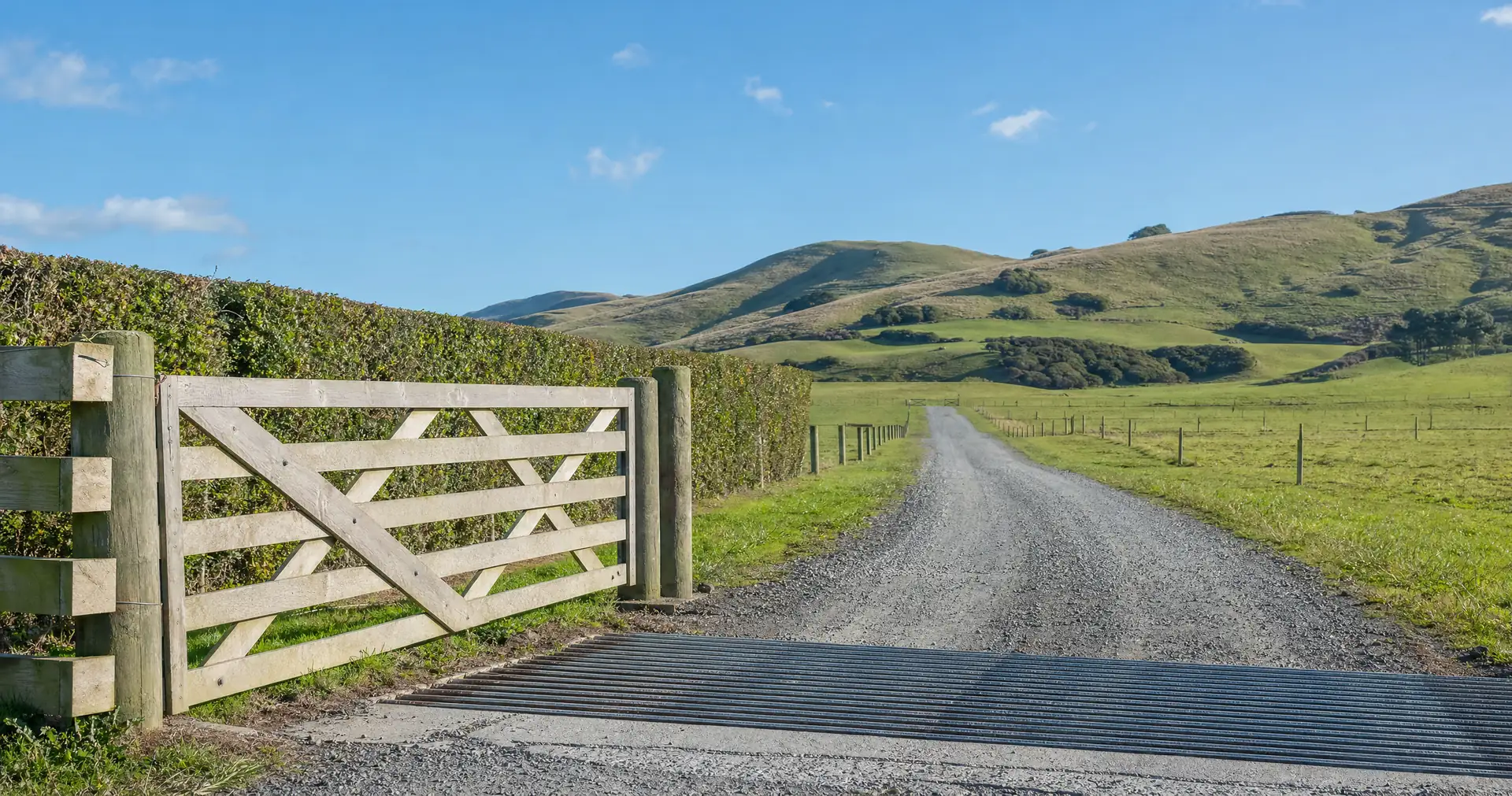
Rural property lending starts from how much of the purchase the buyer brings rather than from what the property earns, and that ordering surprises people arriving from residential lending.
Last reviewed 8 September 2026
Indicative repayment
Weekly
$2,340/week
Indicative only. Not a quote or offer of credit. Actual rates, fees, and repayments depend on the business profile and the lender's decision.
Sending to Prospa
5 years at 8.00% . Prospa will ask a few quick questions, then provide a firm quote and funding if eligible.
Redirecting…
The short version
What is being bought
The land and its improvements are the bulk of the price and the part a mortgage secures. Buildings, fencing, laneways, effluent systems and irrigation infrastructure form part of that value rather than sitting outside it, which is why a developed property values above a bare equivalent.
Livestock is frequently sold with the property and is valued separately, on a basis that depends on class and condition. It is ordinarily financed under a different arrangement from the land, which means two facilities and two security positions from day one.
Plant, feed on hand and any co-operative shares attached to supply arrangements complete the picture. Each has its own value, its own funding treatment and its own tax position, and a purchase priced as a single number needs unpicking into these components before it can be financed.
The land
Mortgage-secured
Improvements
Part of the land value
Livestock
Valued and funded separately
Plant and shares
Separate again
Worked example
A property is offered at $4.2m walk-in walk-out. Unpicked, that is roughly $3.4m of land and improvements, $600,000 of livestock, $150,000 of plant and $50,000 of feed and sundries.
A lender assessing the land component at a conservative loan-to-value position might advance around $2.0m to $2.2m against it, which leaves $1.2m or more of the land component to be found from the buyer’s equity. The livestock and plant are then funded under separate arrangements at different rates and terms.
That is why the equity question comes first. The buyer needs the difference on the land component plus whatever the stock and plant facilities do not cover, and the total required is considerably more than a residential purchaser of the same headline price would expect.
Illustrative figures
Illustrative on stated assumptions and rounded. Advance levels vary by lender, sector and property. Not a quote or offer of credit.
What a lender looks at
01
How much of the purchase the buyer brings, and where it comes from. Equity released from an existing property is read differently from cash, because it is borrowing under another name.
02
What the property has carried and produced, and what it could under the buyer’s intended system. A change of system on purchase is a change of assumptions and lenders test it.
03
Whether the purchaser has run this kind of operation before. A first farm purchase and an expansion by an established operator are assessed very differently.
04
Water take consents, effluent systems, nutrient obligations and any outstanding compliance issues. These affect both what the property can produce and what it will cost to hold.
05
Existing debt, off-farm income, other properties and any guarantees already given. A purchase is assessed against the whole balance sheet rather than against the property alone.
The valuation
Rural valuers assess land class, carrying capacity, water availability, improvements and comparable sales in a market where comparables can be scarce, and the resulting figure has more room to differ from expectation than a suburban valuation does. It also takes longer to obtain and costs considerably more. Instructing it early is the single largest influence on whether a purchase settles on time, and a conditional period that assumes a fast valuation is a common source of difficulty.
The costs around it
Indicative categories rather than figures, because each varies widely by property, region and complexity.
| Cost | What it covers | Notes |
|---|---|---|
| Registered valuation | The lender’s valuation of the property | Larger and slower than residential |
| Legal fees | Conveyancing and security documentation | Higher where consents or leases are involved |
| Stock and plant valuation | Livestock and machinery being purchased | Frequently separate specialists |
| Due diligence | Soil, water, effluent and compliance checks | Worth more than it costs |
| Establishment fees | The lender’s facility charges | On each facility, not once |
| Registration and searches | Title and security registration | Small, and unavoidable |
Indicative categories. Actual amounts depend on the property and the advisers engaged.
The due diligence
Water is frequently the most consequential item. Whether a take consent exists, what it permits, when it expires and whether it is transferable can change what the property is worth by a large margin, and the answer is a matter of record rather than opinion.
Effluent and nutrient obligations are the second. A system that does not meet current requirements is a capital cost the purchaser inherits, and the size of it is establishable before settlement rather than after.
Soil, pasture condition, drainage and the state of the improvements complete it. None of this is finance, and all of it affects what the property will earn and therefore what the debt against it can be serviced from, which is why lenders take an interest in whether it was done.
The trade
The honest position
A great many rural purchases fail on equity rather than on the property, and the discovery frequently happens after an offer has been made and conditional finance has been sought. That is an expensive way to learn what a lender will advance.
The alternative is a conversation with a rural lender before looking seriously, establishing what the business can borrow against its existing position and what contribution would be required at various price points. That takes one meeting and it changes what is worth looking at.
It also produces a better transaction when one arrives. A buyer who already knows the shape of the funding can move on a conditional period that is realistic rather than optimistic, which matters in a market where vendors compare conditions as well as prices.
The conditional period
A residential purchase can be conditional on finance for a fortnight and complete comfortably. A rural purchase frequently cannot, because the valuation alone takes longer than that, and the due diligence a lender expects sits alongside it rather than after.
That produces a real tension in a competitive market, where a vendor comparing two offers reads the conditions as well as the price. A shorter conditional period is worth something to a vendor, and a purchaser who offers one they cannot meet is buying an extension they may not get.
The way through it is preparation rather than optimism. A purchaser who has already spoken to a lender, knows what will be advanced against a property of that type and has a valuer in mind can offer a genuinely shorter period. One who starts the process after the offer is accepted is discovering the timeline at the worst moment.
The other purchaser
A great many rural purchases are additions rather than acquisitions: a neighbouring block bought by an established farm to add scale, replace leased country or improve a system. That is assessed differently and frequently more favourably than a first purchase.
The advantages are real. The purchaser has production history, the existing operation can service part of the new debt, and a block adjoining an existing farm frequently produces more in the buyer’s hands than it did in the vendor’s. Lenders read all three.
The risk is that scale is assumed to solve itself. A block bought at a price justified by what it will produce under an improved system is a block bought on a forecast, and the servicing has to work on the current system as well. That is a question worth answering before the offer rather than after the valuation.
The debt behind it
The calculator runs the ordinary amortising arithmetic on the borrowed component. A full rural purchase is ordinarily larger and longer than the ranges here. Indicative only, and not a quote or offer of credit.
Indicative repayment
Weekly
$2,340/week
Indicative only. Not a quote or offer of credit. Actual rates, fees, and repayments depend on the business profile and the lender's decision.
Sending to Prospa
5 years at 8.00% . Prospa will ask a few quick questions, then provide a firm quote and funding if eligible.
Redirecting…
References
The authority for title, and for the overseas investment regime affecting some rural purchases.
The agency responsible for rural sector policy and for many of the compliance obligations attaching to farm land.
The source for freshwater, nutrient and effluent regulation affecting what a property can produce.
Context for New Zealand rural lending aggregates and rate movements.
Referenced for the point that a rural purchase and its conditions are matters for a solicitor.
FAQ
Materially more than a residential purchase requires, and how much depends on the lender, the sector and the property. It is the binding constraint on most rural purchases and it is worth establishing before looking rather than after an offer.
Because rural land is assessed on land class, carrying capacity, water availability and improvements alongside comparable sales, and comparables can be scarce. It takes longer, costs more and has more room to differ from expectation.
Ordinarily not. Stock is valued separately and financed under a different arrangement, which means two facilities and two security positions from the outset. Plant and co-operative shares are separate again.
A single price covering the land, improvements, livestock, plant and frequently feed on hand. It has to be unpicked into its components before it can be financed, because each part is valued and funded differently.
Yes. Water take consents, effluent systems and nutrient obligations affect what the property can produce and what it will cost to hold, and lenders assess them as part of value rather than as a separate compliance matter.
Longer than most property transactions, largely because of the valuation and the volume of due diligence. This site does not publish timings, and a conditional period should be set with the valuation timeline in mind.
Water consents and their expiry, effluent and nutrient compliance, soil and pasture condition, drainage and the state of the improvements. Each affects what the property will earn, which is what the debt is serviced from.
Ordinarily yes. Experience running the intended system carries real weight in rural lending, and a first purchase by an operator without that history is assessed more conservatively than an expansion by an established one.
Commonly, and lenders read it as borrowing rather than as cash. It increases total debt across the position and it is assessed as such, which is not the same as a contribution from savings.
New Zealand has an overseas investment regime that applies to certain purchases of sensitive land, administered by Land Information New Zealand. Whether it applies to a particular transaction is a question for a solicitor.
A registered valuation, legal fees, stock and plant valuations, due diligence, establishment fees on each facility, and registration and search costs. Together they are a material sum on a rural transaction.
No. It describes how a transaction is generally financed. This site is not a lender, a law firm or a registered financial adviser, and a rural purchase should proceed with a solicitor and an accountant involved.
Related
Farm term loan
The facility a purchase becomes.
Read onLivestock finance
The separate arrangement covering the stock.
Read onFarm succession finance
Where the purchaser is the next generation.
Read onHow NZ rural lending works
Who lends, and how a purchase file is assessed.
Read onAll eight kinds of finance
Every rural facility compared in the same shape.
Read onDisclaimer
Farm debt is serviced out of a production year that does not arrive evenly, and it is commonly secured on the land and the stock the business depends on. Modelling the cost against the season before committing is what this site is built for. Borrowing at a level that stays comfortable through a poor season, rather than only through an average one, is widely regarded as the safer frame.
What this site is
A calculator and information tool. Not a lender, not a broker, not a registered financial adviser. Nothing here is personalised financial advice.
What the figures show
Modelled estimates based on the inputs shown. Not a quote. Not an offer of credit. Not a guarantee of approval, rate or fees.
What the lender decides
Final rates, fees, and approval are set by the lender after a CCCFA-appropriate assessment of the applicant's circumstances and credit decision.
Commercial disclosure
Farmfinance.org.nz earns a commission from Prospa when a visitor applies through this site and their application is approved. The commission is paid by Prospa, not by the borrower, and it does not influence the rate Prospa offers. Full disclosure on the partner page.
Tax, GST, and accountant framing
Tax-treatment statements (GST claim timing, interest deductibility, depreciation rates) are general in nature and subject to the accountant's confirmation on the specific business position. For material amounts, professional advice from a registered financial adviser or chartered accountant is widely regarded as the safer frame.