
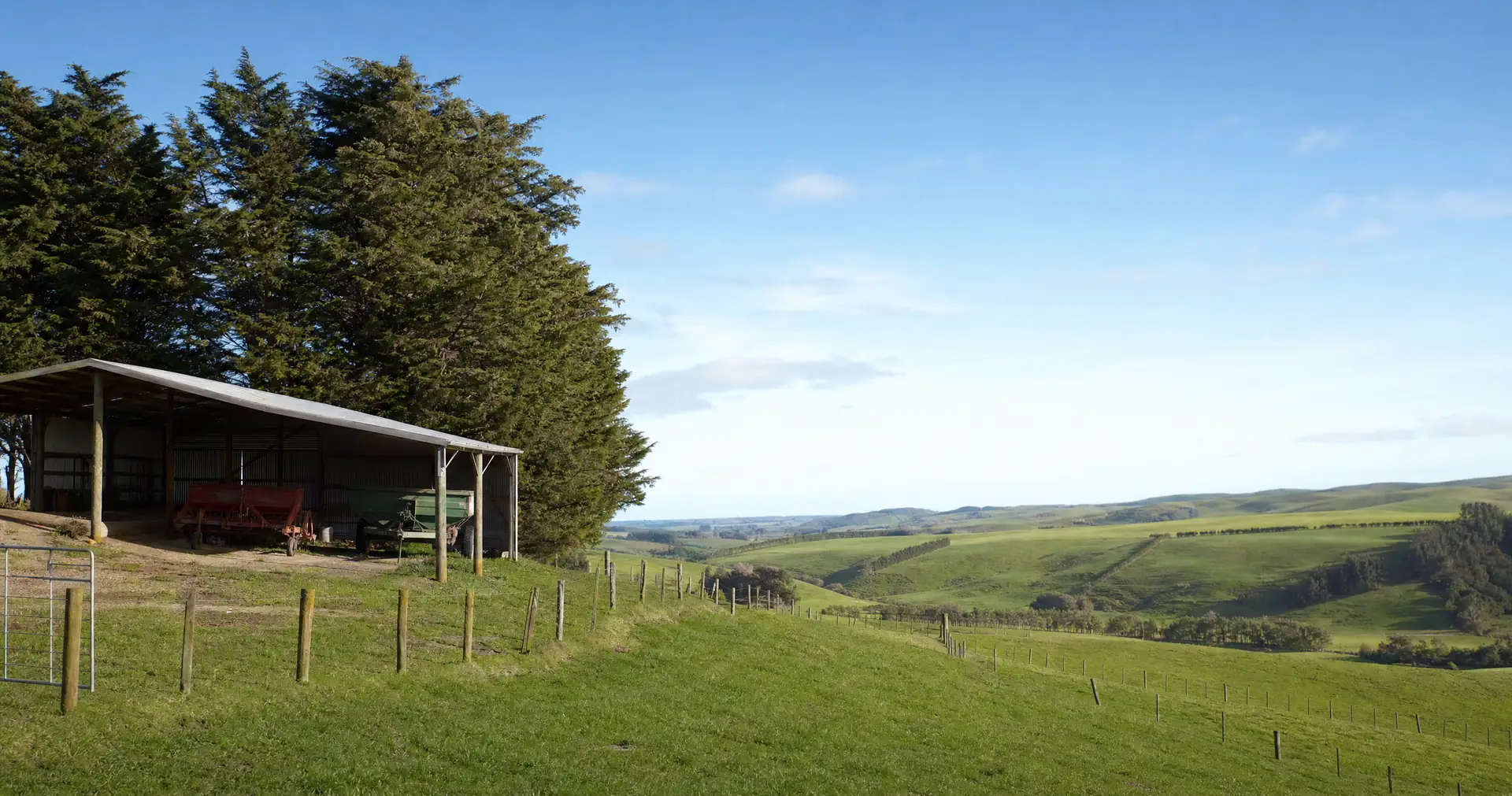
Land, stock and a season that pays at the end.
An independent guide to how New Zealand farms are financed, and a calculator that shows what the debt costs. Rural lending has its own structures, its own assessment and its own annual rhythm, and very little of it resembles ordinary business banking.
Indicative repayment
Weekly
$1,872/week
Indicative only. Not a quote or offer of credit. Actual rates, fees, and repayments depend on the business profile and the lender's decision.
Sending to Prospa
Your $400,000 scenario
5 years at 8.00% . Prospa will ask a few quick questions, then provide a firm quote and funding if eligible.
Redirecting…
What this is
Several kinds of debt, one production year.
A farm does not carry one facility. It carries term debt secured on the land, a seasonal facility that fills and empties with the production year, frequently a livestock arrangement, and whatever plant and infrastructure debt has accumulated. All of it is serviced from one production, and the structure of each affects how much room the others have.
That is what makes rural finance a specialist subject rather than business lending applied to farms. The assessment reads several seasons rather than one, the security spans land, stock, plant and produce, the repayment structures are matched to a calendar, and the annual review is a substantial event.
This site covers each kind of rural finance on its own page, each sector’s cash year in the same shape, and the guides underneath, from who actually lends to what the Farm Debt Mediation Scheme requires. The calculator sits on every page. Nothing here is a quote, nothing is submitted, and no credit file is touched.
Kinds of finance covered
8
Sectors covered
7
Assessed on
Land, production, operator
Personal details collected
None
The finance
Eight kinds of rural lending.
Each page covers what it funds, how it is secured, how repayments are matched to a season, what a lender assesses, and where it sits on a farm balance sheet. Indicative bands only.
Farm term loan
The core debt secured on the land, running for decades. Its structure sets how much room the rest of the operation has.
Read onRural property finance
Buying land, where the equity requirement rather than the price is usually the binding constraint.
Read onFarm succession finance
Moving a farm between generations, where the farm sets the ceiling and the family conversation comes first.
Read onSeasonal finance
The working capital of the production year, drawn as costs are incurred and repaid when income arrives.
Read onSupplier advance finance
Advancing against a scheduled processor or co-operative payment, which is narrower and cheaper than a general facility.
Read onLivestock finance
Security that eats, grows and can be sold in a week, with a tax regime entirely of its own.
Read onFarm machinery finance
Plant on a farm balance sheet, where seasonal repayments and the own-or-contract question both matter.
Read onIrrigation finance
Infrastructure with a payback measured in decades, resting on a consent with a term attached.
Read onSide by side
What actually differs between the four largest.
The production is the same. What differs is what secures the debt, how long it runs and how it is repaid.
| Term loan | Seasonal facility | Livestock | Machinery | |
|---|---|---|---|---|
| Secured on | The land | The business and produce | The animals | The plant |
| Length | Decades | A season | Months to years | Three to five years |
| Repaid from | Production, over time | The season’s income | Stock sales or production | Production, on a schedule |
| Repayment shape | Can be seasonal | Clears each year | Amortising | Can be seasonal |
| Security value in a bad year | Broadly holds | Falls with production | Falls with the season | Broadly holds |
| Reviewed | Periodically | Annually | Annually | At the outset |
How the four largest rural facilities differ. Indicative only, and not an offer of credit.
The decision underneath
Two questions settle most of it.
Question one
How long until this is paid for.
An asset that produces for decades wants long debt, and one that turns over in a season wants a facility that clears in a season. Getting that wrong is the single most common structural error in rural finance.
A development financed over five years against a block that produces nothing for three puts most of the repayment before any of the benefit. A season funded by extending term debt hides the signal a seasonal facility would have given.
Matching the length of the debt to the life of the thing it funded is close to the whole of good structure, and it is a conversation with a lender about structure rather than about rate.
Question two
When does this farm actually get paid.
A dairy farm receives money monthly, a cropping business once a year, a forestry block once in a generation. Those are entirely different funding problems and they use the same word for the industry.
The gap between spending and being paid determines how deep a seasonal facility has to be, how much a delayed payment hurts and when a facility should be arranged.
It is knowable from twelve months of bank statements plotted on one line, and a farm that arrives at its lender with that picture is presenting the thing a rural credit assessment is trying to construct.
The number to record
The lowest point the seasonal facility reaches, each year.
A seasonal facility is judged on whether it clears rather than on how deep it goes. Recording the least drawn it reaches in each season, beside the two before it, takes two minutes a year and is the earliest available signal that the season has stopped covering the year. A floor rising across three seasons says something a set of accounts will not show as plainly for another twelve months, and it says it while there are still options.
By sector
Seven production calendars.
Each page covers where the money goes, when it comes back, where the year is tightest and what the finance around it has to do.
Dairy
Paid monthly at an advance rate against a forecast that moves during the season.
Read on At saleSheep and beef
Income in a handful of events, with stock as product, inventory and security at once.
Read on After harvestHorticulture
Years of establishment before a first crop, then labour costs concentrated into weeks.
Read on After vintageViticulture
The longest establishment of any crop, and inventory in tank if the business makes wine.
Read on Once a yearArable and cropping
A whole year of inputs before one sale, producing the deepest drawdown in New Zealand farming.
Read on Once a rotationForestry
A cash cycle measured in decades, funded against the land rather than against production.
Read on After the flowApiculture
A year of work for weeks of production, with volume and price both capable of moving a long way.
Read onThe honest limit
What this site cannot tell you.
Every rate band here is indicative. Nobody publishing a website in New Zealand can say what a particular farm will be charged, because the price depends on land, production history, equity, security, the operator and a credit assessment, and only the lender sees all of them.
The tax framing has a harder limit. Livestock valuation, development expenditure, GST on rural transactions and the treatment of a succession all depend on facts a website cannot see, which is why every tax statement here carries the accountant caveat in the same sentence as the claim.
This site is an education site and a calculator. It is not a lender, a broker or a registered financial adviser, and nothing on it is personalised financial advice.
References
Sources
- Personal Property Securities Register
Backs the statements about the security interest a livestock or machinery facility ordinarily registers.
- External Reporting Board
The publisher of the standards governing how current assets and liabilities are classified.
- Inland Revenue, GST
The published source for GST as a current liability with fixed due dates.
- Commerce Commission
The regulator whose guidance covers lender conduct and fee disclosure.
- Financial Markets Authority, financial advice
Backs the distinction drawn between class information and regulated financial advice.
FAQ
Rural finance in New Zealand, questions answered
Who lends to New Zealand farms?
Bank agribusiness divisions provide most rural debt, alongside non-bank rural lending specialists, stock and station firms extending seasonal credit, and asset financiers funding machinery. Most farms use more than one.
How is a farm assessed differently from other businesses?
Across several seasons rather than one, on land that is valued for what it can produce, with real weight on the operator’s experience and management, and against the whole debt position rather than the new facility alone.
Why does a farm carry several facilities at once?
Because the assets have different lives. Land wants decades of debt, a season wants a facility that clears annually, and stock and plant sit between. Matching each to its purpose is most of what good structure means.
What is a seasonal facility?
A revolving facility drawn as production costs are incurred and repaid when the season’s income arrives. It is the working capital of almost every New Zealand farm, and interest runs on what is drawn rather than on the limit.
Can repayments be matched to the season?
Frequently yes, with larger amounts after payout, harvest or sale and smaller ones between. It has to be asked for because an even schedule is the default, and the effect on a farm’s year is considerable.
What is the Farm Debt Mediation Scheme?
A statutory scheme requiring a lender to offer mediation before enforcing against farm property. A farming business can also request it, which is the part fewest people know, and it has its own guide on this site.
How should a seasonal facility be sized?
Against the deepest point of the drawdown in the worst of the last three seasons, taken from the bank statements, with a margin. Sizing on the average leaves the business short at the point nothing can be done.
When is the best time to arrange a facility?
At the strongest point of the year, which is generally after the main receipt when the facility has cleared and the season’s results are in. The terms available differ materially from those offered mid-trough.
Does this site arrange finance?
No. It is an education site with a calculator and one disclosed referral to Prospa. There is no contact form, no application, and no personal details are collected anywhere on the site.
Is anything here financial advice?
No. This site is not a lender, a broker or a registered financial adviser. It provides general information about how rural finance works, and what suits a particular farm depends on facts a website cannot see.
Related
Where to next
All eight kinds of finance
Every rural facility compared in the same shape.
Read onAll seven sectors
Where each production calendar puts the money.
Read onHow NZ rural lending works
Who lends, and what they are reading.
Read onThe Farm Debt Mediation Scheme
The statutory step before any enforcement.
Read onFarm loan calculator
What the debt costs, on your own figures.
Read on